 (316) 844-0235
 Contact Us

Unlocking AI Visibility: How GEO, AEO, and AI SEO Make Your Business Discoverable in the Age of Intelligent Search
Quick answer: To be found and cited by AI systems like ChatGPT, Bing Copilot, and Gemini, Publish well-structured, EEAT-rich content in Q&A format, implement JSON-LD schema, fix crawlable HTML basics, submit your sitemap to Google and Bing, allow reputable AI crawlers while blocking training-only bots, and earn off-site authority with reviews, directories, and credible backlinks. Build pillar pages with concise summary answers, bullet points, evidence, and FAQs, then update them weekly with new Q&A clusters.
Ford Saeks · Hall of Fame Keynote Speaker · CEO, Profit Rich Results
· 10 min read
Why AI Visibility Matters More Than Traditional SEO
Search is now conversational. Clients ask AI tools for recommendations, plans, and suppliers. If those systems cannot parse, trust, and cite your content, you lose discoverability, leads, and revenue. The solution is not tricks. The solution is clarity, structure, and proof that earns citations.
- Discovery: AI must be able to crawl and understand your pages.
- Trust: Your brand must demonstrate experience, expertise, authority, and trustworthiness.
- Extractability: Your pages must present short, quotable answers that LLMs can lift with confidence.
The GEO, AEO, and AI SEO Trifecta
| Element | Focus | Primary Goal |
|---|---|---|
| GEO · Google Entity Optimization | Brand identity, NAP, local relevance | Visibility in Maps, knowledge panels, and local packs |
| AEO · Answer Engine Optimization | Conversational Q&A and extractable blocks | Citations in AI answers |
| AI SEO | Schema, clean HTML, media transcripts | Machine readability across LLMs |
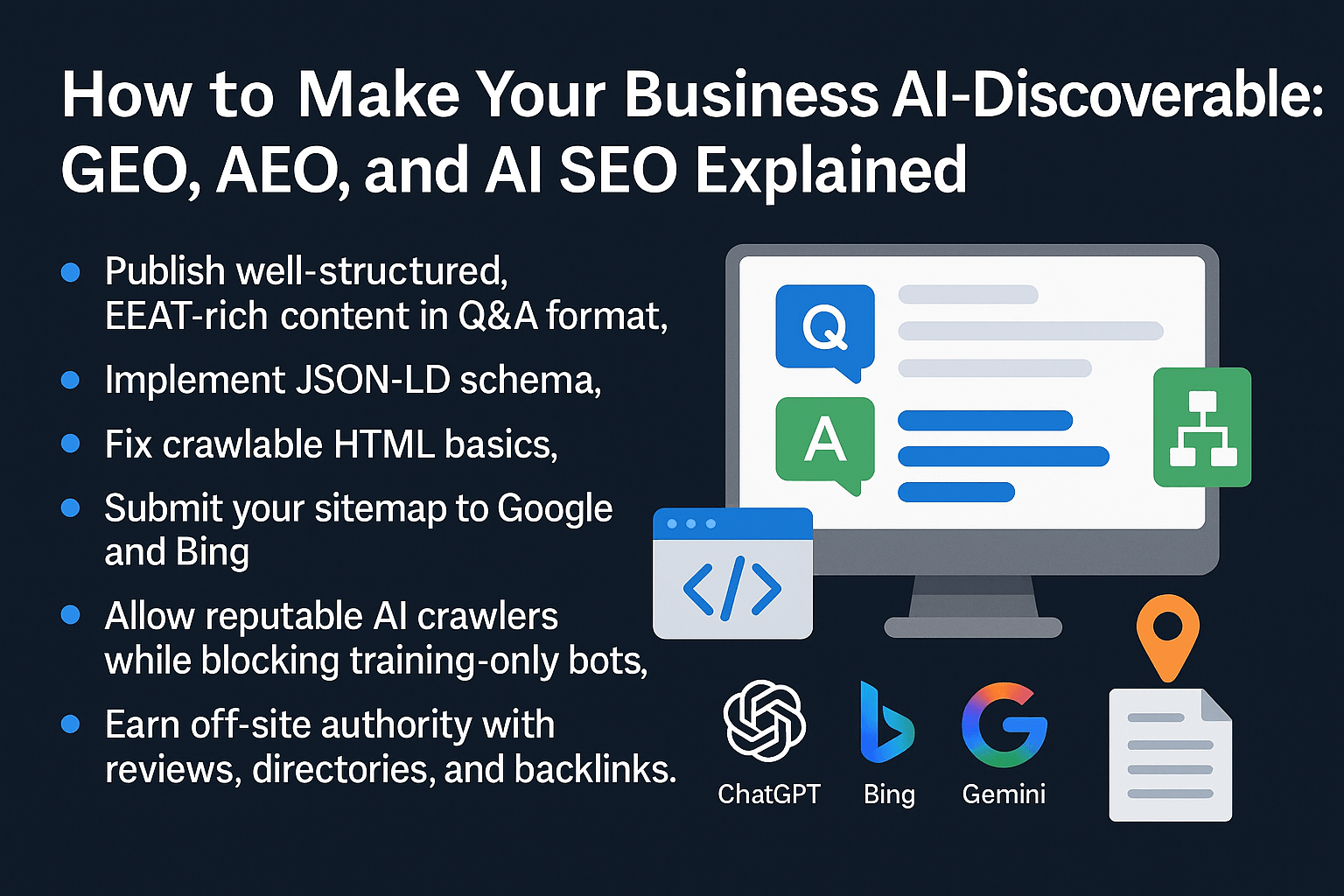
Step 1. Write Content AI Loves
Create pages that answer real questions in natural language and show proof of experience.
Editorial rules
- Use questions with H2s and H3s, for example, “What is AEO?” and “How do I implement schema?”
- Open with a 2 to 4-sentence summary answer. Follow with numbered steps, lists, or a short table.
- Add case studies, quotes, and links to reputable sources where useful.
- Show EEAT with client outcomes, certifications, awards, and bylines.
- Include images with descriptive alt text and provide transcripts for any embedded video.
Mini case example
A regional brand launched an AI-optimized pillar page with schema, a 100-word answer box, and a 5-question FAQ. Within 6 weeks, they saw new inquiries referencing “found you in Bing Copilot” and “Perplexity recommended you”.
Step 2. Fix the Technical Foundation
- HTML over hidden JS: Make sure primary copy renders as HTML. Avoid placing core text in JavaScript that bots cannot see.
- Media accessibility: Add alt text to every image. Use captions and transcripts for video and audio.
- Sitemaps: Maintain XML sitemaps per section. Submit in Google Search Console and Bing Webmaster Tools.
- Performance: Keep Core Web Vitals in the green. Compress media and lazy load below the fold assets.
- Canonical hygiene: Set canonicals, fix duplicate titles, and ensure clean internal linking.

Step 3. Use Schema Markup
Schema is invisible to humans but essential for robots. Use JSON-LD to define what your page contains.
- Organization and Local Business for NAP and brand identity
- Article, FAQPage, Review, VideoObject, and Event, where applicable
If you use WordPress, Rank Math, or Yoast, you can output JSON-LD automatically, or you can paste custom JSON-LD into a code block like the one at the bottom of this post.
Step 5. Control Which AI Crawlers Can Access Your Site
Allow engines that cite sources and drive traffic. Limit training-only crawlers. Verify identity at your WAF to stop spoofed user agents. Below is an example of my ROBOTS.TXT
# robots.txt example
User-agent: Googlebot
Allow: /

User-agent: Bingbot
Allow: /

# AI answer engines that can cite sources
User-agent: OAI-SearchBot
Allow: /
User-agent: ChatGPT-User
Allow: /
User-agent: PerplexityBot
Allow: /
User-agent: Claude-SearchBot
Allow: /
User-agent: Claude-User
Allow: /

# Block training-only or broad scrapers
User-agent: GPTBot
Disallow: /
User-agent: ClaudeBot
Disallow: /
User-agent: CCBot
Disallow: /
User-agent: Google-Extended
Disallow: /
Sitemap: https://profitrichresults.com/sitemap.xml
Tip: Use Cloudflare WAF or your edge provider to verify bot reverse DNS or published IP ranges. Rate limit unknown crawlers.
Step 6. Make Every Page Citation-Ready
- Start with a short summary answer under 100 words.
- Add three to five bullet takeaways and a proof point.
- Include a 3 to 5-question FAQ in plain language.
- Use H2s for questions, tables for comparisons, and numbered steps.
- End with a clear CTA that matches the search intent.
AI Visibility Checklist
- Submit the XML sitemap to Google and Bing.
- Implement JSON-LD for organizations, articles, FAQ pages, and any event or video.
- Fix HTML readability, media alt text, and transcripts.
- Publish one Q&A article per week linked from a pillar page.
- Refresh your Google Business Profile with new photos, posts, and Q&A monthly.
- Acquire reviews that mention outcomes and services.
- Track AI citations, impressions, and non-brand inquiries in your analytics.
Frequently Asked Questions
What is AEO
AEO means Answer Engine Optimization. It focuses on structured, conversational content that AI systems can extract, trust, and cite in their answers.
How is AI SEO different from traditional SEO
Traditional SEO targets blue link rankings. AI SEO prioritizes machine readability, schema, FAQs, and short answer blocks that large language models can reuse with confidence.
Which schema types are most important
Start with Organization and Article, then add FAQPage, VideoObject, Event, Review, and LocalBusiness if relevant to the page.
Do I need to change my robots.txt
Yes, if you want to encourage engines that cite your work while limiting training-only crawlers. Verify real bots with WAF rules to prevent spoofing.
How fast will I see results
Many sites see early signals within 30 to 60 days after launching pillar pages and Q&A clusters, especially when combined with directory hygiene and review velocity.
0 Comments